The word “commercial-grade” gets stamped on a lot of bar stools that would not survive a month in an actual bar. For a home kitchen island it rarely matters, but if you are furnishing a restaurant, a taproom, or a hotel lobby and buying stools by the dozen, the gap between a residential stool and a genuinely commercial one is the gap between a chair that lasts eight years and one you are replacing after a single busy season. The difference is not marketing; it is a set of measurable specifications you can ask for and check. Here is what actually separates a commercial-grade bar stool from a domestic one, and how to read a spec sheet before you commit to a bulk order.
Weight capacity is the number that gives it away
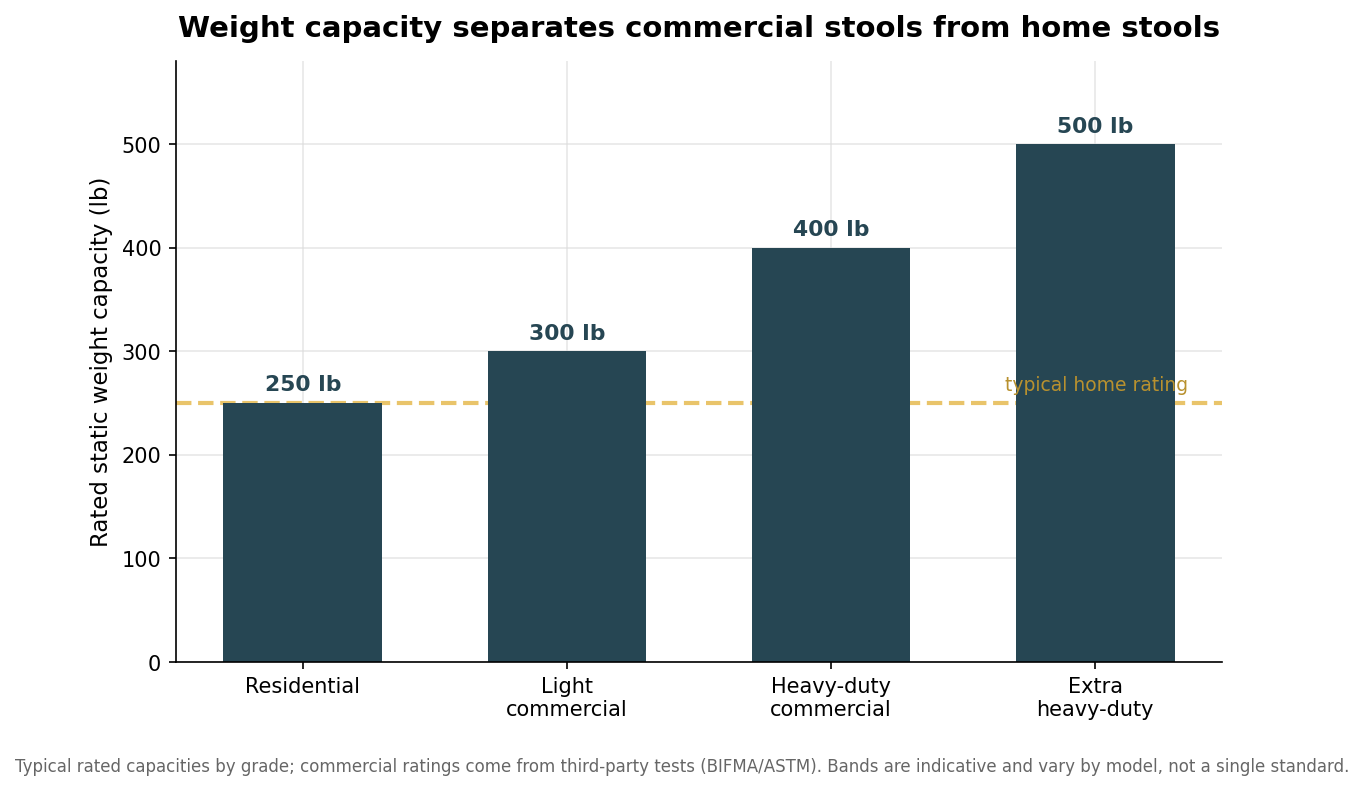
Rated capacity is the fastest way to sort real commercial stools from repackaged home ones. A typical residential stool is built to support around 250 pounds, which is fine for occasional use by a known set of people. A commercial stool is built to support 350 pounds or more, and heavy-duty models are rated higher still, because a public venue has to hold up every guest who sits down, lean-back included, thousands of times a year. That higher number is not a marketing figure on good stools; it is the result of passing structured load tests. When a rating is quoted, ask whether it reflects third-party testing or is simply the manufacturer’s own claim, because the two are not the same thing.
Steel gauge and joinery: where the strength lives
Capacity comes from construction, and two details tell most of the story. The first is steel gauge on metal stools. Residential frames commonly use 22- or 24-gauge tube, while commercial frames use 16- to 18-gauge, and here a lower number means thicker, stronger metal. That single specification explains why a commercial frame feels heavier in the hand and does not flex when a guest rocks back on it. The second detail is how the joints are made. On wood stools, commercial construction uses mortise-and-tenon joints reinforced with glue and screws, often with additional H or D stretchers between the legs to spread load and resist racking, whereas cheaper stools rely on dowels or brackets that loosen over time. On metal, look for fully welded joints rather than bolted ones, and a powder-coated, baked finish that resists the rust and chipping a bar’s spills and cleaning chemicals will otherwise cause. Pay attention to the footrest as well: it takes the most abuse of any part of a bar stool, so commercial models protect it with a metal foot ring or a replaceable kick plate rather than leaving bare wood or paint to scuff through within months.
Upholstery that survives: double rubs
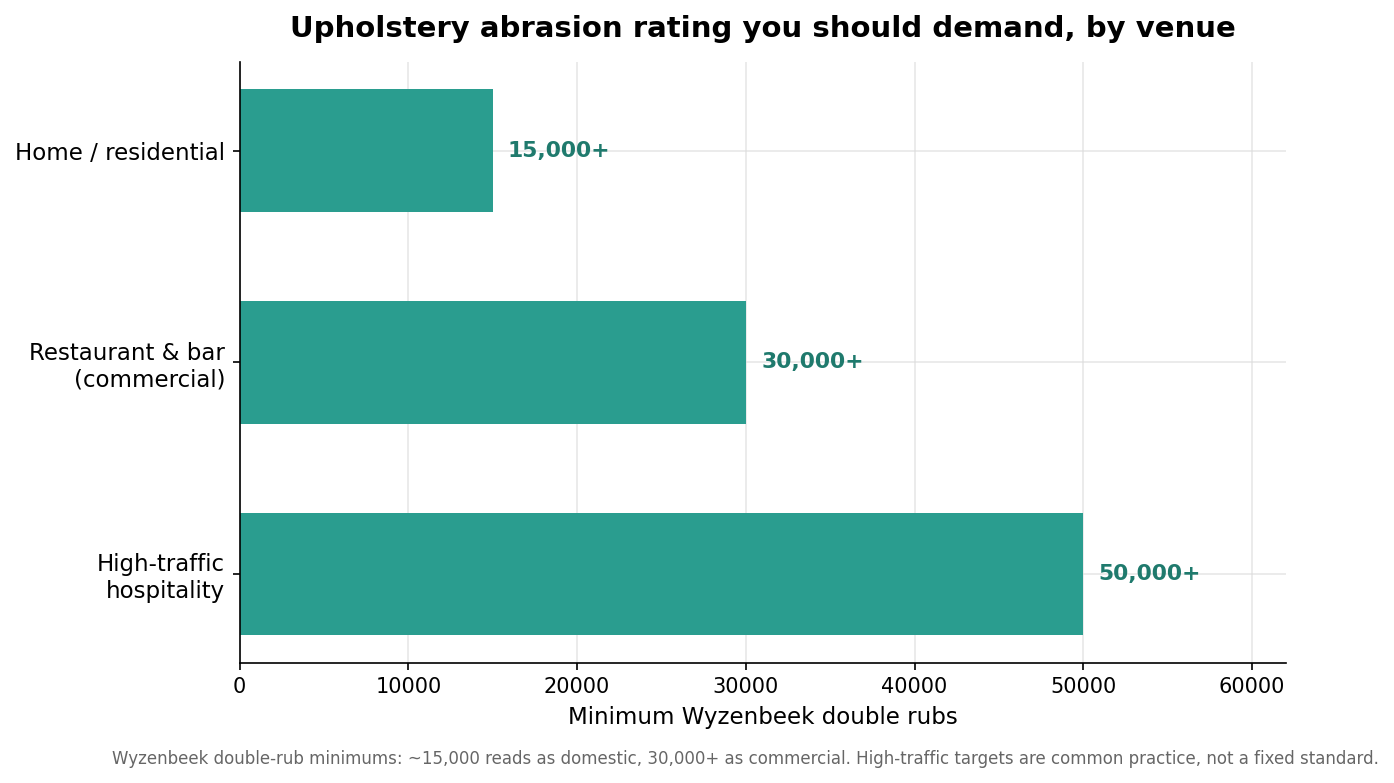
If your stools are upholstered, the seat fabric or vinyl has its own durability spec, and it is the one buyers most often overlook. Abrasion resistance is measured in double rubs using the Wyzenbeek test, where a machine rubs the fabric back and forth until it shows wear. As a working rule, a fabric rated around 15,000 double rubs reads as domestic-grade, while 30,000 or more is the threshold for commercial settings, and busy hospitality venues often specify considerably higher. The European equivalent, the Martindale test, runs on a different scale, where roughly 20,000 cycles is domestic and 40,000 or more is commercial, so if a supplier quotes Martindale numbers do not compare them directly against Wyzenbeek figures. For a bar or restaurant seat that takes daily traffic, denim, and cleaning, treat 30,000 Wyzenbeek double rubs as your floor and go higher for a high-volume room.
The tests behind a commercial-grade claim
Because “commercial-grade” is not a regulated phrase, the credible signal is third-party testing. Genuinely commercial seating is put through structured protocols by independent bodies such as BIFMA, ASTM, and ANSI, which run procedures like a back-rest strength test, a seating drop test, a stability test, and a leg-strength test to failure. A stool that carries a BIFMA or ASTM pass has demonstrably survived those loads; one that only says “heavy-duty” on the listing has demonstrated nothing. The warranty is a useful secondary tell, because a manufacturer’s willingness to stand behind a product tracks how it was built. Residential metal stools often carry only a one-to-six-month warranty and wood a single year, while commercial lines commonly offer multi-year coverage on wood and a lifetime structural warranty on metal frames. A long structural warranty is a manufacturer betting its own money that the frame will not fail.
Reading a spec sheet before a bulk order
Turn all of this into a short checklist you run against any quote. Confirm a rated weight capacity of at least 350 pounds and ask whether it is third-party tested. On metal, confirm 16- to 18-gauge steel, welded joints, and a powder-coated finish; on wood, confirm mortise-and-tenon joinery with stretchers. If the seat is upholstered, require a Wyzenbeek rating of at least 30,000 double rubs, higher for a high-traffic venue, and ask for commercial-grade vinyl or contract fabric rather than a residential textile. Look for a named BIFMA, ASTM, or ANSI pass and a multi-year or lifetime structural warranty. Finally, order a single sample stool and put it through a hard week before the full run lands, since a specification failure is far cheaper to catch on one stool than on forty. Lead times and minimum order quantities on custom commercial stools are typically measured in weeks and vary by material, finish, and decoration, so treat any timeline as indicative until your supplier confirms it against your actual order.
Win Free Stuff
Enter below for a chance to win plus receive 10% off your first order.
🎉 You are in!
Check your email for your 10% off code. Good luck!