Category: Uncategorized

  • Bar Stool Seat Materials Compared: Vinyl, Faux Leather, Leather, Wood, and Metal

    Bar Stool Seat Materials Compared: Vinyl, Faux Leather, Leather, Wood, and Metal

    The seat is the part of a bar stool that fails first. The frame can be rated for a decade of daily use, but if the seating surface cracks, peels, or stains in the first busy season, the whole stool looks tired and you are buying again. Choosing the seat material is therefore the decision that most determines whether a stool is a three-year purchase or a ten-year one. This comparison lines up the five materials you will actually be quoted, judged on the specs that matter: abrasion resistance, cleanability, comfort, and cost.

    Before comparing anything, it helps to have one yardstick. For upholstered surfaces the industry uses the Wyzenbeek test, which counts double rubs until the fabric or vinyl shows wear. The Association for Contract Textiles sets 15,000 double rubs as the heavy-duty minimum for commercial upholstery, and that number is the floor, not the target. Good commercial vinyl clears it many times over. Hard surfaces like wood and metal are not abrasion-tested this way because there is no coating to rub through, which is a clue about where they fit.
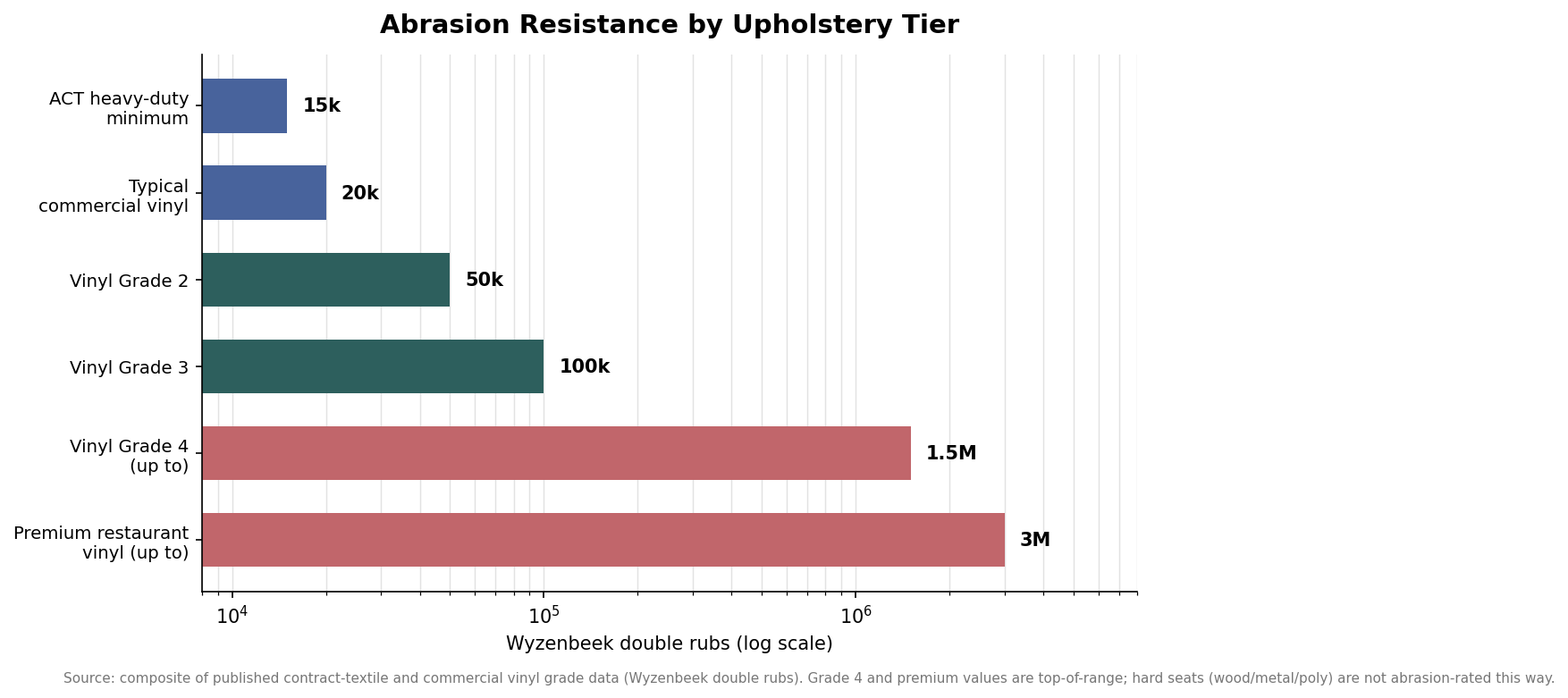
    Horizontal bar chart on a log scale comparing Wyzenbeek double-rub abrasion ratings across upholstery tiers, from the ACT heavy-duty minimum of 15,000 to premium restaurant vinyl at up to 3 million
    Abrasion resistance by upholstery tier; Grade 4 and premium figures are top-of-range, and hard seats are not abrasion-tested this way.

    Commercial vinyl: the default for a reason

    Vinyl is the workhorse of hospitality seating because it survives spills and wipes clean in one pass. Most commercial vinyls are graded, and a common framework runs from Grade 2 to Grade 4. Grade 2 starts around 50,000 double rubs, is the budget choice, and is best kept to indoor, light-to-medium traffic. Grade 3 is the sweet spot for most bars and restaurants: roughly 100,000 double rubs, typically bleach-cleanable and antimicrobial, with cold-crack resistance down to about minus 10 degrees Fahrenheit and strong colorfastness. Grade 4 climbs from 100,000 into the seven figures depending on the pattern, adds cold-crack tolerance to around minus 20 degrees, and carries the UV and moisture resistance that make it viable in sunrooms or covered patios.

    The practical read is simple. If your stools live in a high-turnover dining room or a bar where drinks get set down on seats, specify Grade 3 as your baseline and only step up to Grade 4 where sunlight, temperature swings, or extreme traffic justify the premium. Stepping below Grade 3 to save a few dollars per stool is usually a false economy in a commercial room.

    Faux leather and genuine leather: look versus upkeep

    Faux leather, sold as PU or bonded leather, is chosen for a softer, more upscale hand than standard vinyl at a moderate price. The trade-off is longevity: polyurethane surfaces are prone to peeling and delamination under the constant sliding and abrasion of bar seating, and the cheaper bonded versions fail fastest. Faux leather earns its place in boutique or lounge settings where the look matters and traffic is moderate, but it is not the material to specify for a sports bar that turns tables all night.

    Genuine leather is the premium option and feels like it, developing a patina that vinyl cannot imitate. It is genuinely durable when maintained, but it demands conditioning, dislikes standing moisture, and stains from spilled cocktails and food oils if not cleaned promptly. Reserve it for upscale venues with lower turnover and staff who will maintain it, and keep it away from wet-heavy service. In pure cost-per-year of hard use, a Grade 3 vinyl usually beats genuine leather in a busy room, which is why so many high-end operators still choose a premium vinyl that looks like leather.

    Wood, metal, and poly: when no upholstery wins

    Hard seats skip the abrasion question entirely. A solid wood seat, well finished, wipes clean, resists the peeling and staining that plague upholstery, and reads as warm and classic. The cost is comfort: without a cushion, wood is a shorter-sit material, which is fine for high-turnover counters and cafes and less ideal where guests linger. Metal seats, typically steel or aluminum, are close to indestructible and shrug off abuse, spills, and weather, which is why they dominate industrial-look bars and outdoor use; they too are a hard, cool surface better suited to shorter sits. Poly or resin seats split the difference for outdoor and poolside settings, resisting UV and moisture at a low-to-moderate price while tolerating rough handling.

    For any outdoor or damp environment, the seat material conversation is really a frame conversation too. Powder-coated steel resists corrosion well indoors and in covered outdoor use; for exposed patios, aluminum or stainless framing avoids the rust that will eventually undercut even a perfect seat. Match the frame finish to the exposure or the stool will fail from the legs up regardless of what you sit on.
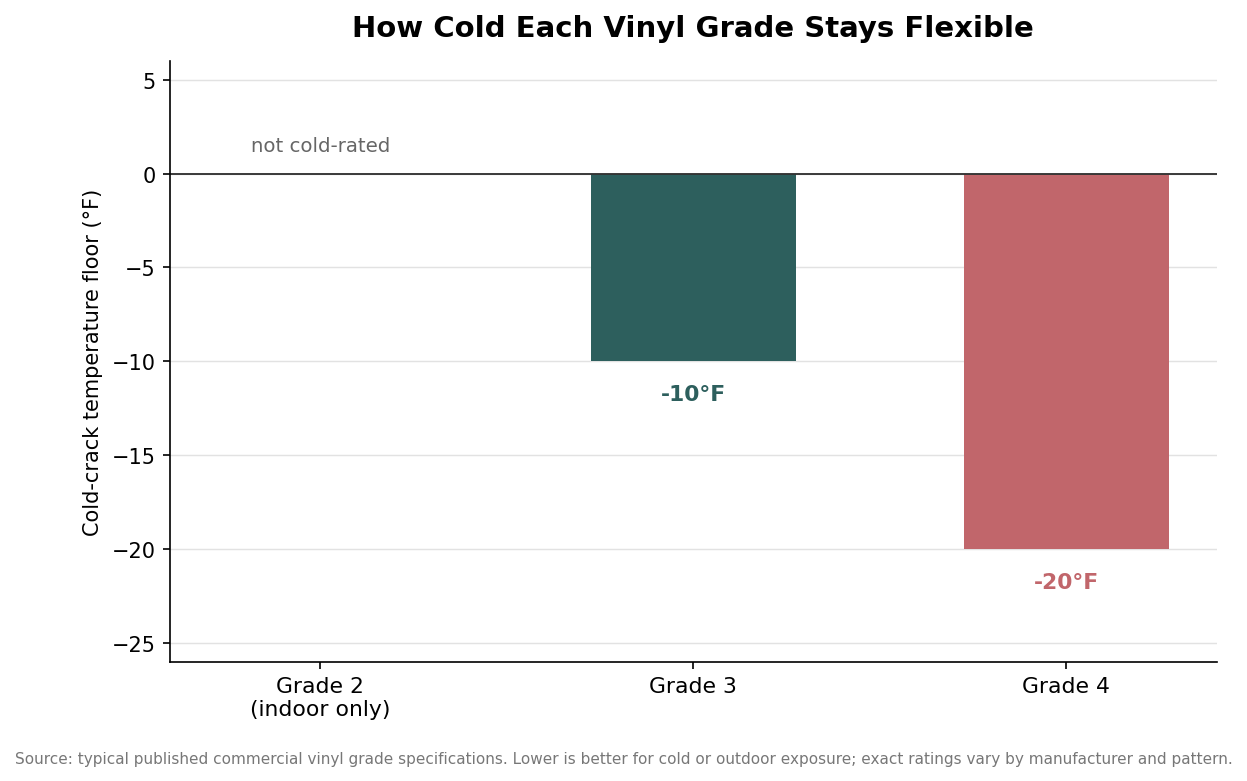
    Vertical bar chart of cold-crack temperature floors by commercial vinyl grade, showing Grade 3 to about minus 10 degrees Fahrenheit and Grade 4 to about minus 20 degrees, with Grade 2 rated indoor only
    How cold each vinyl grade stays flexible; lower is better for cold or outdoor exposure. Figures are typical grade values and vary by manufacturer.

    Matching the seat to the room

    Put the materials against your actual service and the choice narrows quickly. A high-volume bar or restaurant that turns seats constantly and mops up spills nightly wants Grade 3 commercial vinyl: it hits roughly 100,000 double rubs, cleans with bleach solution, and forgives abuse. A boutique lounge or upscale dining room with slower turnover can justify faux or genuine leather for the look, accepting the higher upkeep, or hedge with a premium leather-look vinyl. A cafe, brewery, or high-turnover counter where sits are short and durability trumps plushness is a natural home for wood or metal, which never peel and barely age. An outdoor or poolside bar points to metal, poly, or a Grade 4 vinyl over a corrosion-resistant frame.

    Two habits separate buyers who get this right. First, ask for the double-rub rating in writing rather than accepting the word commercial, which is unregulated; a real spec sheet will list a number. Second, request a swatch or seat sample and abuse it: wipe it with your cleaning chemicals, set a cold glass on it, flex it. The seat surface is where a stool lives or dies, and ten minutes with a sample tells you more than any product photo about how it will look after a year of your particular room.
  • How to Space and Size Bar Stools So Every Seat Actually Works

    How to Space and Size Bar Stools So Every Seat Actually Works

    A bar can look finished on the drawings and still seat people badly. The seats sit too high for the top, elbows collide, and the two stools at the end are unusable because a wall is in the way. Almost all of that comes down to three numbers you can lock in before anything is ordered: the seat height, the spacing between seats, and the clearance around each stool. Get those right and a custom run of branded stools will fit the room and stay comfortable through a long shift.

    Match the seat height to the surface first

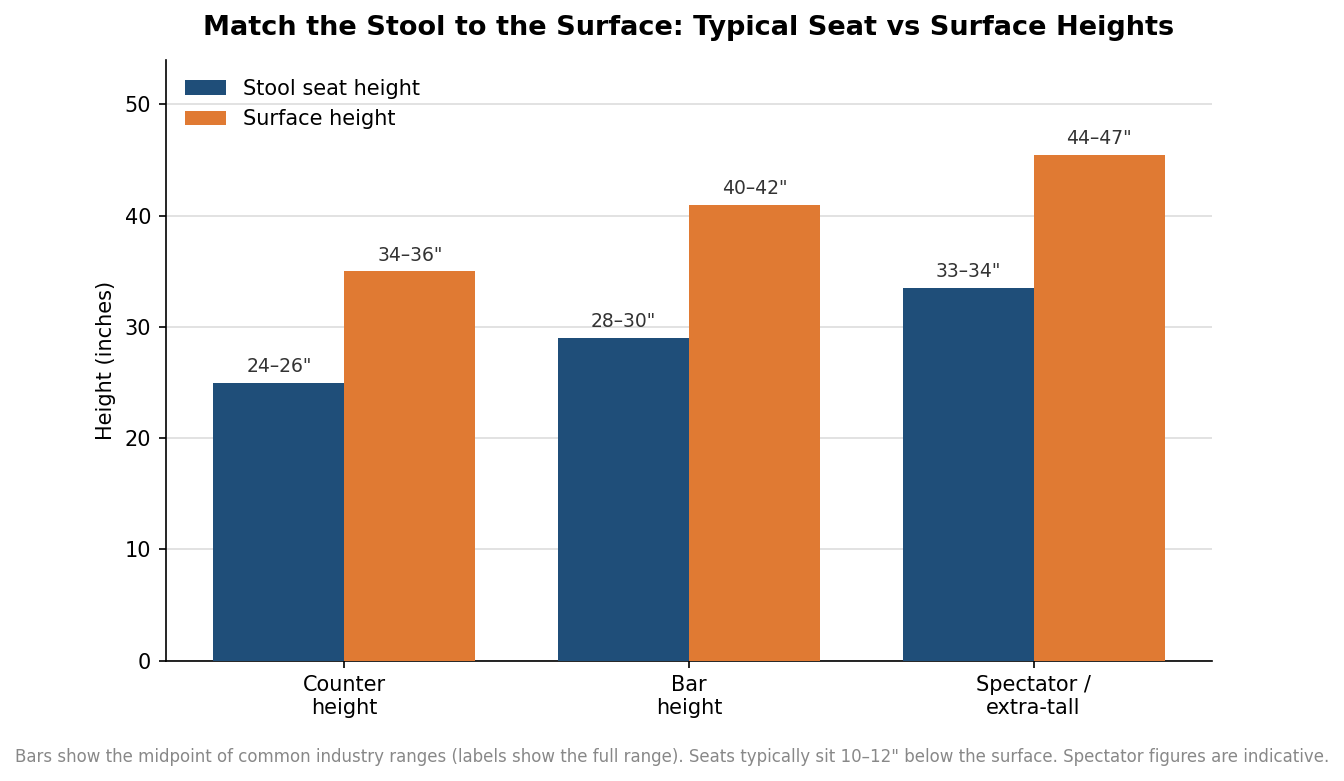
    The surface height decides the stool, not your preference. Standard kitchen and reception counters run 34 to 36 inches, and they take a counter-height stool with a seat around 24 to 28 inches; most land at 24 to 26. A true bar or high-top surface runs 40 to 42 inches and needs a bar-height stool with a seat of 28 to 30 inches. Taller spectator or pub tables in the 44 to 47 inch range call for extra-tall stools with seats near 33 to 34 inches; treat those spectator figures as indicative, since they vary more by maker.

    The reliable rule underneath all of this is the gap between the seat and the top. Aim for the seat to sit roughly 10 to 12 inches below the surface, which leaves about 9 to 12 inches of legroom between the seat and the underside of the counter. If a guest’s knees hit the apron under the top, the stool is too tall for that surface no matter what the label says. Measuring the finished surface height, rather than assuming it from the cabinet spec, is the single step that prevents the most reorders.

    Grouped bar chart comparing stool seat heights to surface heights for counter, bar, and spectator heights
    Counter, bar, and spectator stools each pair with a specific surface height range.

    Give every stool its own 24 inches

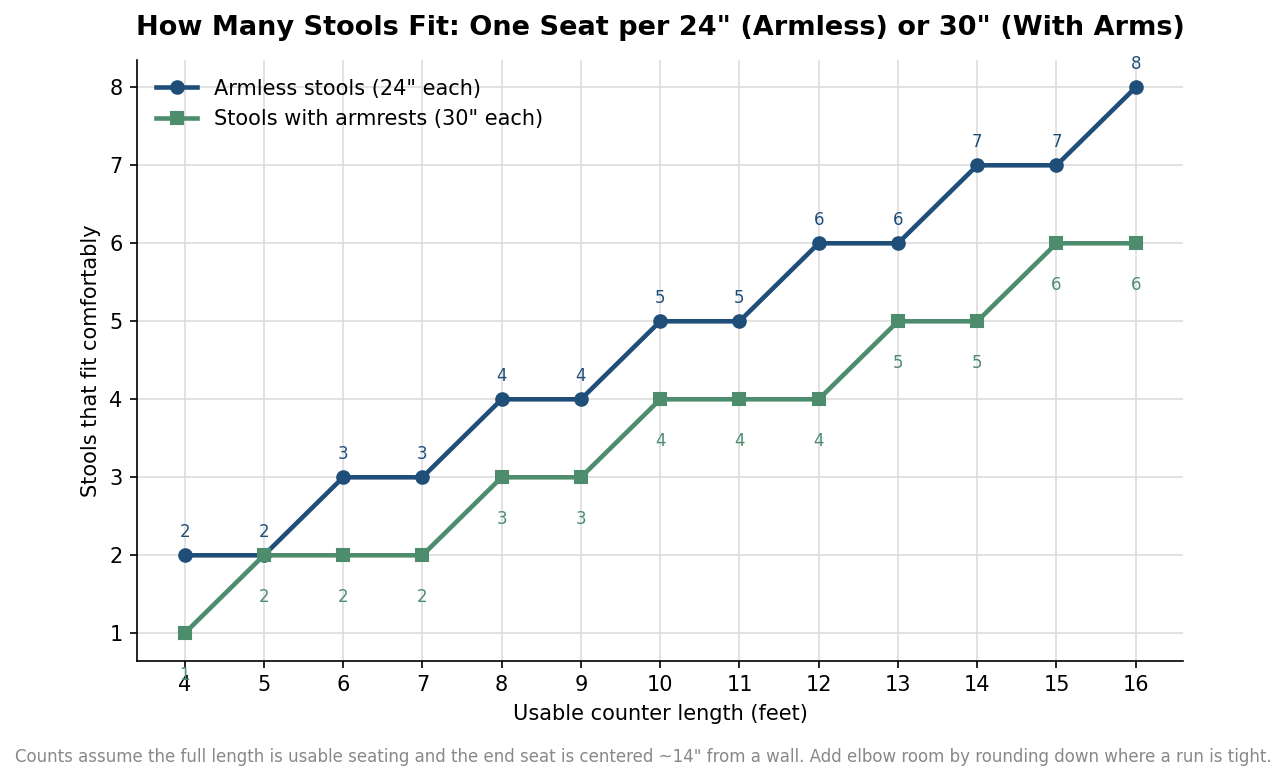
    Plan one armless stool for every 24 inches of usable counter, measured center to center. That works out to roughly one seat per two feet of bar. Stools with armrests need more room and should be spaced about 30 inches apart so the arms clear. Between the seats themselves, keep at least 6 inches for elbows; 8 to 10 inches is where it stops feeling cramped. To size a run quickly, divide the usable length in inches by 24 for armless stools or by 30 for models with arms, then round down.

    An eight-foot run, for example, is 96 inches, which divides into four armless stools with comfortable spacing or three stools with arms. Where a run ends at a wall, center the last seat about 14 inches off the wall so nobody is wedged into the corner. It is better to seat one fewer stool than to line them up shoulder to shoulder, especially in a commercial setting where turnover depends on people actually wanting to sit there.

    Line chart showing how many armless versus armrest stools fit as counter length grows
    Dividing counter length by 24 inches (armless) or 30 inches (with arms) gives a comfortable seat count.

    Leave room behind the stool, not just under it

    Clearance behind the seat is where layouts quietly fail. A counter overhang of 10 to 12 inches lets seats tuck partly underneath, and you want 12 to 18 inches of knee space so legs are not pinned. Backless and saddle-style seats, usually around 12 inches deep, tuck the cleanest and are worth considering where floor space is tight or where stools need to disappear under the counter between services.

    Behind the row, allow about 24 inches from the counter edge so a person can pull the stool out and stand. If that same space doubles as a walkway for staff or other guests, add a real traffic aisle on top of it, on the order of 30 to 36 inches, so someone getting up does not block the path. These are the dimensions that separate a bar that photographs well from one that works during a rush.

    Build in at least one accessible seat

    Public-facing bars should include an accessible section, and it is cheap to plan for up front. Accessibility guidance points to a portion of the counter at 34 inches high and at least 36 inches of clear width, with knee clearance beneath it in the range of 27 inches high, 30 inches wide, and 19 inches deep. Meeting that usually means leaving one open stretch of lower counter rather than buying a special stool, so it costs layout planning more than money. Even a home bar benefits from one lower, easier seat for guests who do not want to climb onto a 30-inch perch.

    How the layout changes what you order

    Once the spacing is set, the rest of the specification follows from it. Backless stools maximize how many seats you can tuck into a short run and keep sightlines open, while stools with backs are more comfortable for longer sitting but eat into your spacing and need the wider 30-inch pitch. Swivel seats suit tight rows because guests turn instead of scooting the whole stool out; fixed seats are steadier and simpler to keep aligned. A footrest at a consistent height keeps the row looking uniform and takes strain off the legs.

    Branding placement is a layout decision too. On stools with backs, the outer face of the backrest is the panel people see from across the room as they walk in, which makes it the natural home for a logo. On backless stools there is no back to print, so the seat apron or a footring band becomes the visible surface. Deciding seat style and spacing before you commit to a custom print run means the artwork lands where it will actually be seen, at a size that reads from across the room, rather than being squeezed onto whatever surface is left over.

    Work in this order and the project holds together: measure the finished surface height, pick the matching stool height, divide the length by 24 or 30 for your seat count, then confirm the clearance behind and one accessible stretch. Every later choice, down to where the logo goes, gets easier once those numbers are fixed.

  • What Makes a Bar Stool Commercial-Grade

    What Makes a Bar Stool Commercial-Grade

    The word “commercial-grade” gets stamped on a lot of bar stools that would not survive a month in an actual bar. For a home kitchen island it rarely matters, but if you are furnishing a restaurant, a taproom, or a hotel lobby and buying stools by the dozen, the gap between a residential stool and a genuinely commercial one is the gap between a chair that lasts eight years and one you are replacing after a single busy season. The difference is not marketing; it is a set of measurable specifications you can ask for and check. Here is what actually separates a commercial-grade bar stool from a domestic one, and how to read a spec sheet before you commit to a bulk order.

    Weight capacity is the number that gives it away

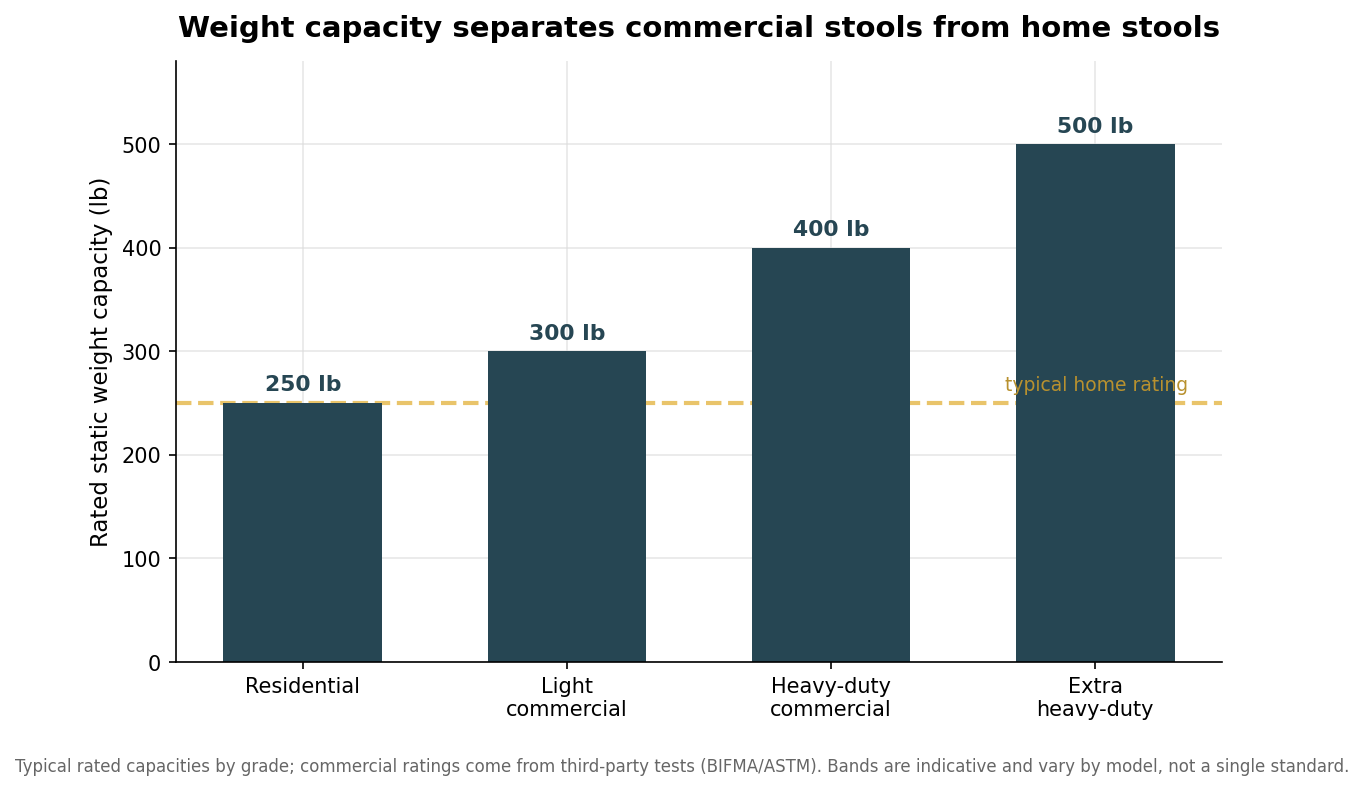
    Rated capacity is the fastest way to sort real commercial stools from repackaged home ones. A typical residential stool is built to support around 250 pounds, which is fine for occasional use by a known set of people. A commercial stool is built to support 350 pounds or more, and heavy-duty models are rated higher still, because a public venue has to hold up every guest who sits down, lean-back included, thousands of times a year. That higher number is not a marketing figure on good stools; it is the result of passing structured load tests. When a rating is quoted, ask whether it reflects third-party testing or is simply the manufacturer’s own claim, because the two are not the same thing.

    Bar chart of rated weight capacity in pounds by bar stool grade, from 250 lb residential to 500 lb extra heavy-duty commercial
    Rated weight capacity by stool grade, with the typical home rating marked.

    Steel gauge and joinery: where the strength lives

    Capacity comes from construction, and two details tell most of the story. The first is steel gauge on metal stools. Residential frames commonly use 22- or 24-gauge tube, while commercial frames use 16- to 18-gauge, and here a lower number means thicker, stronger metal. That single specification explains why a commercial frame feels heavier in the hand and does not flex when a guest rocks back on it. The second detail is how the joints are made. On wood stools, commercial construction uses mortise-and-tenon joints reinforced with glue and screws, often with additional H or D stretchers between the legs to spread load and resist racking, whereas cheaper stools rely on dowels or brackets that loosen over time. On metal, look for fully welded joints rather than bolted ones, and a powder-coated, baked finish that resists the rust and chipping a bar’s spills and cleaning chemicals will otherwise cause. Pay attention to the footrest as well: it takes the most abuse of any part of a bar stool, so commercial models protect it with a metal foot ring or a replaceable kick plate rather than leaving bare wood or paint to scuff through within months.

    Upholstery that survives: double rubs

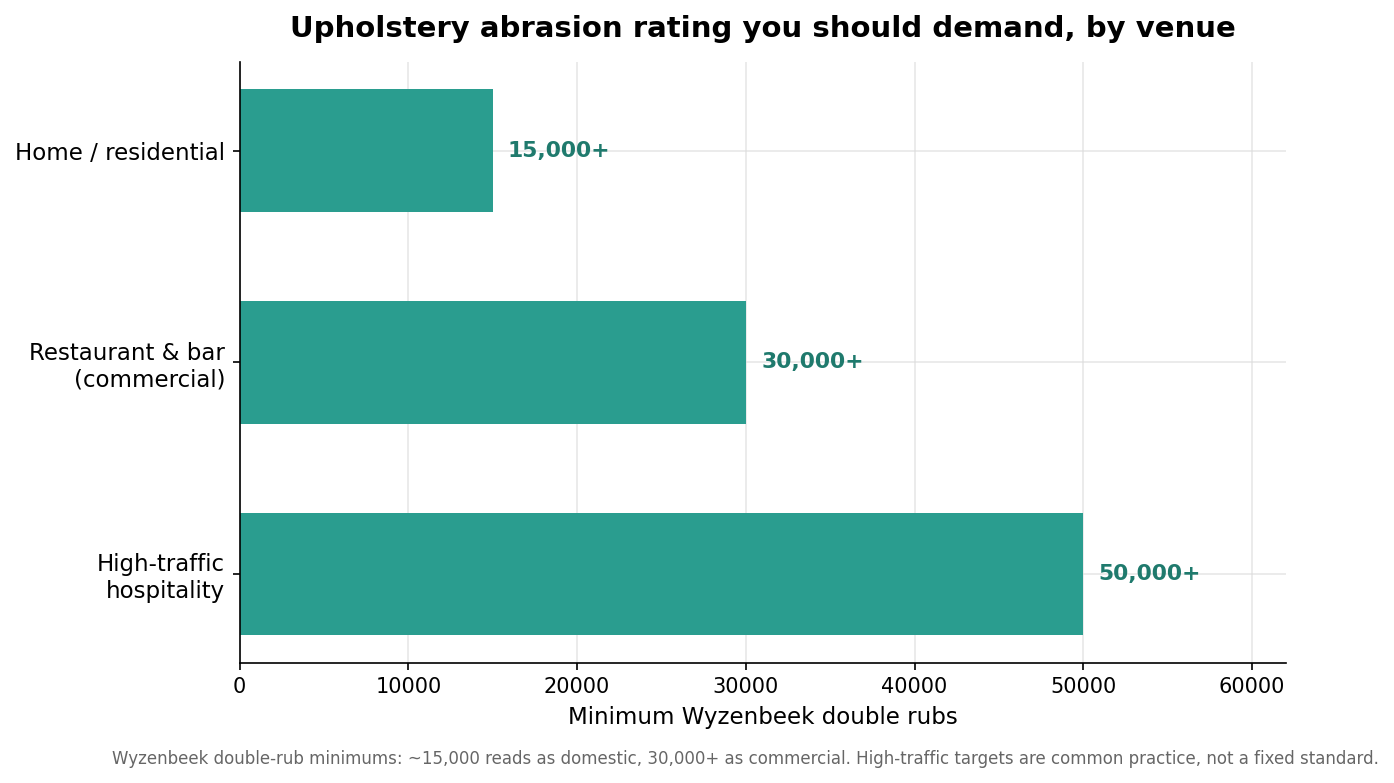
    If your stools are upholstered, the seat fabric or vinyl has its own durability spec, and it is the one buyers most often overlook. Abrasion resistance is measured in double rubs using the Wyzenbeek test, where a machine rubs the fabric back and forth until it shows wear. As a working rule, a fabric rated around 15,000 double rubs reads as domestic-grade, while 30,000 or more is the threshold for commercial settings, and busy hospitality venues often specify considerably higher. The European equivalent, the Martindale test, runs on a different scale, where roughly 20,000 cycles is domestic and 40,000 or more is commercial, so if a supplier quotes Martindale numbers do not compare them directly against Wyzenbeek figures. For a bar or restaurant seat that takes daily traffic, denim, and cleaning, treat 30,000 Wyzenbeek double rubs as your floor and go higher for a high-volume room.

    Horizontal bar chart of minimum Wyzenbeek double-rub upholstery ratings by venue, from 15,000 residential to 50,000-plus high-traffic hospitality
    Minimum upholstery abrasion rating to demand by how busy the venue is.

    The tests behind a commercial-grade claim

    Because “commercial-grade” is not a regulated phrase, the credible signal is third-party testing. Genuinely commercial seating is put through structured protocols by independent bodies such as BIFMA, ASTM, and ANSI, which run procedures like a back-rest strength test, a seating drop test, a stability test, and a leg-strength test to failure. A stool that carries a BIFMA or ASTM pass has demonstrably survived those loads; one that only says “heavy-duty” on the listing has demonstrated nothing. The warranty is a useful secondary tell, because a manufacturer’s willingness to stand behind a product tracks how it was built. Residential metal stools often carry only a one-to-six-month warranty and wood a single year, while commercial lines commonly offer multi-year coverage on wood and a lifetime structural warranty on metal frames. A long structural warranty is a manufacturer betting its own money that the frame will not fail.

    Reading a spec sheet before a bulk order

    Turn all of this into a short checklist you run against any quote. Confirm a rated weight capacity of at least 350 pounds and ask whether it is third-party tested. On metal, confirm 16- to 18-gauge steel, welded joints, and a powder-coated finish; on wood, confirm mortise-and-tenon joinery with stretchers. If the seat is upholstered, require a Wyzenbeek rating of at least 30,000 double rubs, higher for a high-traffic venue, and ask for commercial-grade vinyl or contract fabric rather than a residential textile. Look for a named BIFMA, ASTM, or ANSI pass and a multi-year or lifetime structural warranty. Finally, order a single sample stool and put it through a hard week before the full run lands, since a specification failure is far cheaper to catch on one stool than on forty. Lead times and minimum order quantities on custom commercial stools are typically measured in weeks and vary by material, finish, and decoration, so treat any timeline as indicative until your supplier confirms it against your actual order.

  • Counter Height vs Bar Height: Get This Right First

    Call or Text us: (929) 605-4397
    Specs

    Counter Height vs Bar Height: Get This Right First

    One measurement, taken before anything else

    This is the one decision in stool buying that cannot be fixed after delivery. It takes one measurement and about thirty seconds, and it is skipped constantly.

    How to measure

    Measure from the floor to the UNDERSIDE of the counter, not the top. The underside is what determines legroom, and it is where an overhang or a support rail will actually stop a guest’s knees.

    What each height is for

    Counter height suits kitchen islands, service counters and most cafe counters. Bar height suits a true bar with a raised drinking rail. A bar-height stool at a counter leaves guests perched too high with nowhere comfortable to put their legs, and the room simply does not get used.

    Watch the overhang

    Two counters at the same height can take different stools if one has a deep overhang and the other does not. If your counter has a substantial lip, backless stools tuck under it far better than anything with a back.

    Send us the number

    Give us the floor-to-underside measurement with your enquiry and we will confirm the correct height against the style you want, on your mockup, before anything is made. Minimum order is 12 stools and production runs 2 weeks.

    Create your custom bar stools now.

    Send your logo, quantity and date — you’ll get a free mockup and quote within one business day.

    Get a Quote
    GET A QUOTE
  • Where to Put Your Logo on a Bar Stool So It Lasts

    Call or Text us: (929) 605-4397
    Branding

    Where to Put Your Logo on a Bar Stool So It Lasts

    The branding has to outlast the fit-out

    Branded furniture only works if the branding survives as long as the furniture. On a stool, three surfaces are available and they age very differently.

    The seat top: most visible, least durable

    It is the first surface a guest sees, which makes it tempting. It is also the surface that takes the most direct wear. A print there will show its age first, so treat it as a medium-term option rather than a permanent one.

    The upholstery panel: the balanced choice

    Embroidered or debossed into the seat or back panel, a logo reads as part of the furniture and wears at the same rate as the upholstery around it. For most venues this is the right answer.

    The footrest ring: effectively permanent

    Cast or laser-etched into metal, the mark is cut into the material rather than sitting on it. Wear softens the edges rather than removing it. If you are fitting out a signature venue you intend to keep, this is the one to specify.

    You can combine them

    An etched footrest for permanence and an embroidered seat panel for visibility is a common pairing and quotes as a single order. Minimum order is 12 stools, production runs 2 weeks, and the mockup is free within 24 hours.

    Create your custom bar stools now.

    Send your logo, quantity and date — you’ll get a free mockup and quote within one business day.

    Get a Quote
    GET A QUOTE
  • Custom Bar Stools: A Buyer’s Guide

    Call or Text us: (929) 605-4397
    Buyer’s guide

    Custom Bar Stools: A Buyer’s Guide

    Height first, everything else second

    Stools are the most-used furniture in any bar and the most commonly mis-specified. Get the height, the back and the branding surface right and they outlast two fit-outs. Get them wrong and you replace them inside a year.

    Counter height and bar height are different products, not adjustable preferences. Measure from the floor to the underside of the counter before you look at a single style. Ordering the wrong height is the most expensive mistake in this category and it cannot be corrected afterwards.

    Decide what the back is for

    Backless maximises seat count and keeps walkways clear, which suits high-turnover bars. A low back keeps guests seated longer, which suits rooms where dwell time is the business model. Pick based on how the room actually earns, not on how the stool looks in a photo.

    Do not skip the swivel

    Without a swivel, guests drag the stool every time they turn to talk. That is what destroys floors and stool feet. It is a small cost at order time and a large one to fix later.

    Put the branding where it survives

    A print on a seat wears through. Embroidery into upholstery lasts far longer. A logo cast or laser-etched into the footrest ring is effectively permanent, because it is cut into metal rather than applied to a surface. Choose based on how long you want the branding to last.

    What to expect when you order

    Send your counter measurement and whatever artwork you have. You will get a free mockup within 24 hours, unlimited free revisions, and you pay nothing until you approve it. Minimum order is 12 stools and production runs 2 weeks, with faster turnaround available on express shipping.

    Create your custom bar stools now.

    Send your logo, quantity and date — you’ll get a free mockup and quote within one business day.

    Get a Quote
    GET A QUOTE
  • Hello world!

    Welcome to WordPress. This is your first post. Edit or delete it, then start writing!